
CEDV Statement October 21,2026
Children Experience the Impact of Domestic Violence Too
Domestic and intimate partner violence affects more than the adults directly involved. Nationally, an estimated 1 in 4 children live in a household where domestic violence is present sometime during their lifetime. In Vermont, a 2025 survey found that domestic violence was part of the reason 430 children were not safe in their home. For 75% of those children and youth, domestic violence was identified as a factor that had prevented or was preventing returning to live with their parents.
Children who see, hear, or live with violence between caregivers can be profoundly affected, even when they are not physically injured or directly targeted. Children may experience fear, confusion, grief, and the loss of their sense of safety. It impacts the very core of who they are and how they see the world.
Children depend on the adults around them for security and care. That is compromised when domestic violence is present. This reality reminds us that the impact extends beyond the immediate incident. They carry the, sometimes invisible, effects of what happened long after the immediate danger has passed and may experience ongoing fear, confusion, and grief.
These experiences matter. The absence of physical injury does not mean the absence of harm. During October, Domestic Violence Awareness Month, it is important to recognize and respond to the impacts on children too. Every child deserves to grow up in an environment where they feel safe.
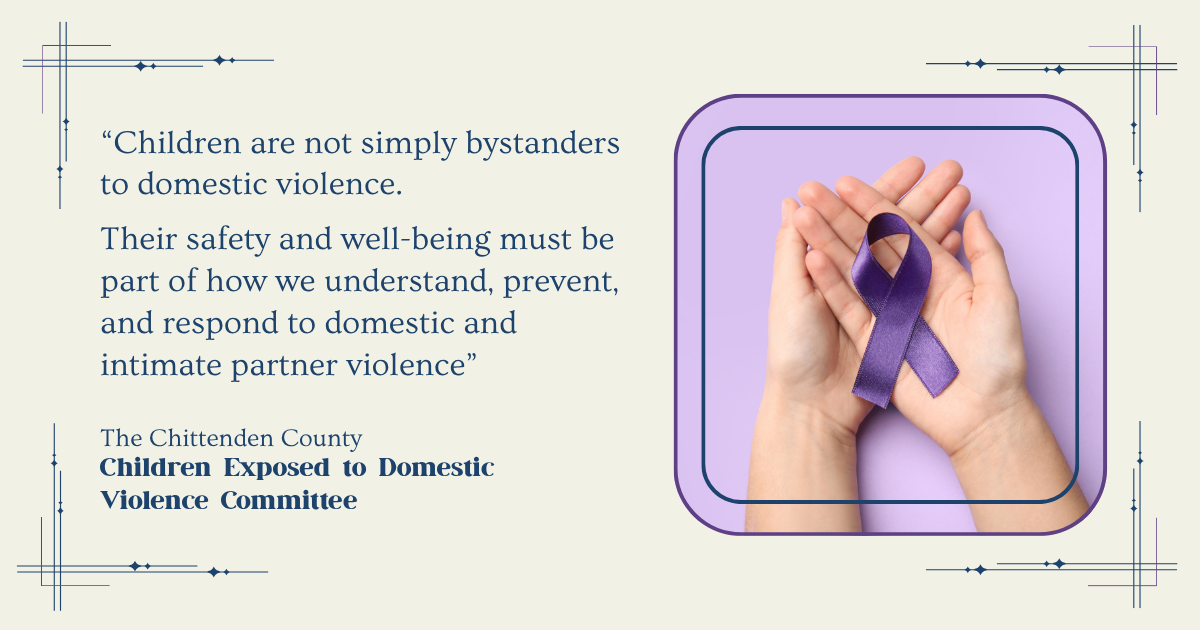
Children are not simply bystanders to domestic violence. They deserve to be believed and protected in the same way adult victims are. Their safety and well-being must be part of how we understand, prevent, and respond to domestic and intimate partner violence. That requires awareness, collaboration, and a shared commitment across both our communities and the systems and organizations that support children and families. We must recognize children's experiences, take their needs seriously, and ensure the impact on them is never overlooked.
The Chittenden County Children Exposed to Domestic Violence Committee
Meghan Masterson, Co-Chair, KidSafe Collaborative Lauren Porell, Co-Chair, Steps to End Domestic Violence
Sources
- Thackeray, J. D., Livingston, N., Ragavan, M. I., et al. (2023). Intimate partner violence: Role of the pediatrician. Pediatrics, 152(1), e2023062509. https://doi.org/10.1542/peds.2023-062509
- Vermont Council on Domestic Violence. (2025, September 17). Council meeting minutes: Department for Children & Families 2025 domestic violence survey results (pp. 4–5). State of Vermont. https://static1.squarespace.com/static/5e1e13c0f657290d1909a910/t/69caeb00769a861d677f2246/1774906112891/Sept%2B17%2B2025%2Bminutes.pdf
- Kitzmann KM, Gaylord NK, Holt AR, Kenny ED. Child witnesses to domestic violence: a meta-analytic review. J Consult Clin Psychol. 2003 Apr;71(2):339-52. doi: 10.1037/0022-006x.71.2.339. PMID: 12699028.
- National Child Traumatic Stress Network. Intimate Partner Violence: Effects. https://nctsn.org/what-is-child-trauma/trauma-types/intimate-partner-violence/effects


